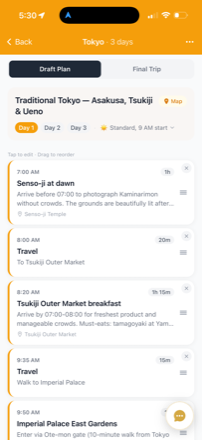
Get this guide as a tappable itinerary — freeDay-by-day plan, audio tours, one-tap Google Maps
Plan My TripSix tested escapes from the city — fairy-tale palaces, turquoise coves, medieval walls, and Roman ruins. All within two hours of Lisbon.
Powered by ITINE
Day-by-day plan, audio tours, and one-tap Google Maps — completely free.
Destinations
Your Itinerary
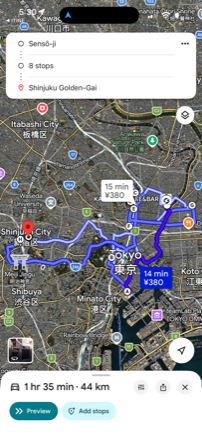
Google Maps
Sintra (40 min), Cascais (35 min), Setúbal & Arrábida (45 min), Óbidos (1 hr), Évora (1.5 hr), Mafra (50 min). All reachable by public transport except Arrábida's beaches, which need a car or tour. Every route below includes exact transport details, costs, the best things to do, and one restaurant worth the trip alone.
The one everyone does first — and for good reason. UNESCO-listed Sintra packs more visual drama per square kilometre than almost anywhere in Portugal. Palaces erupt from forested hilltops, hidden gardens tumble into ravines, and the whole town smells faintly of pine and damp stone.
Train from Rossio Station
40 minutes
€2.45
The wildly colourful Romanticist palace perched above the clouds is Sintra's unmissable centrepiece. Buy tickets online — queues at the gate can be two hours long.
An eccentric estate with a 27-metre initiation well you descend into via a spiral staircase. More atmospheric and less crowded than Pena.
The twin chimneys in the centre of town belong to this medieval royal palace — the best-preserved in Portugal and easy to reach on foot from the train station.
Incomum
Modern Portuguese cooking in a quiet garden. Far better than the tourist cafes near the palace gates.
€50 – 80
Transport + entry tickets + lunch
Buy Pena Palace tickets online the night before and arrive at the palace by 09:30. Crowds triple by 11am.
For the complete palace-by-palace breakdown, see our dedicated Sintra itinerary guide.
A former fishing village turned upmarket seaside town. The train ride itself is the attraction — 35 minutes of Atlantic coastline, estuaries, and whitewashed villas. Cascais is the easiest, most relaxed day trip from Lisbon.
Train from Cais do Sodré
35 minutes
€2.30
The cobbled centre is compact and charming — small fish restaurants, azulejo-faced buildings, and a covered market selling local produce and pastries.
"Mouth of Hell" — a dramatic sea arch carved by Atlantic waves, a 2km walk west of the town. Sunsets here are spectacular.
A small, sheltered beach right in town. Not Algarve-sized, but the calm water and backdrop of painted villas make it one of the most photogenic beaches near Lisbon.
Casa da Guia
A complex of restaurants and shops in a restored 19th-century mansion with sea views. Good fish and local wine.
€30 – 50
Transport + lunch. No paid entries needed.
Sit on the right side of the train for coastal views after Estoril — the sea appears suddenly and stays the whole way.
The best beaches within reach of Lisbon. The Serra da Arrábida natural park tumbles into a coastline of limestone cliffs and improbably blue water — the colour looks Mediterranean, because it is. Setúbal's fish market is one of the best in Portugal.
Bus from Sete Rios
45 minutes to Setúbal
€4.50
Drive or tour through steep limestone hills covered in Mediterranean scrub, with vertiginous views over turquoise coves below. The Portinho da Arrábida beach is the most famous stop.
Consistently rated one of Portugal's finest beaches — a narrow strip of pale sand backed by chalk-white cliffs, reachable only by a short hike or boat. The water is extraordinary.
One of the best covered markets in Portugal. Arrive before noon to see the fish stalls at their most spectacular — local fishers bringing in the morning catch.
Casa do Chico
Simple Setúbal seafood restaurant near the waterfront. Order the choco frito (fried cuttlefish) — it's the local speciality.
€40 – 60
Transport + car hire or tour + lunch
Rent a car or join a guided tour — buses to Arrábida beaches are very limited. Most Lisbon operators run half-day tours for €35–50.
A medieval walled village so perfectly preserved it looks like a film set. White-and-blue houses, bougainvillea spilling over ancient stone, and the best cherry liqueur in Portugal served in a chocolate cup. Small, charming, and completable in half a day.
Bus from Sete Rios
1 hour
€8
A complete circuit of the 13th-century walls rewards you with views over the village rooftops and the surrounding plains. Free to walk, no guardrails — take care.
Óbidos cherry liqueur (ginjinha) served in an edible chocolate cup is the town's signature experience. Get it from any of the small shops on the main street.
The castle at the top of the village is now a pousada (historic hotel). Non-guests can explore the exterior — the views from the towers justify the walk up.
Petrarum Domus
A reliable restaurant inside the walls with an outdoor terrace. Good regional dishes and not overpriced for a tourist village.
€25 – 40
Transport + lunch. No paid entries required.
Go on a weekday. Weekend crowds make the narrow main street uncomfortably packed and restaurants fill up by noon.
The capital of the Alentejo and Portugal's best-preserved medieval city. A Roman temple stands improbably intact in the town centre. A chapel built from human bones lines every wall with skulls. Alentejo wine flows freely. Évora is the most culturally rewarding day trip from Lisbon.
Train from Oriente Station
1.5 hours
€12
Fourteen granite Corinthian columns rising from the centre of town — a 1st-century temple that survived only because it was walled into the medieval castle. Extraordinarily evocative at dusk.
Built by Franciscan monks from the bones of 5,000 people, this 16th-century chapel is one of the most unsettling sights in Europe. Worth the trip alone.
The largest medieval cathedral in Portugal, with a rooftop terrace that gives the best panoramic view of the city and surrounding Alentejo plains.
Botequim da Mouraria
A legendary Alentejo wine bar that also serves food. Only 20 seats — arrive early or book ahead. The migas and black pork are outstanding.
€40 – 70
Train + entries (Roman temple free, Cathedral ~€4) + lunch
The Chapel of Bones alone justifies the train fare. Combine it with the Roman Temple and a long lunch with Alentejo wine and you have a near-perfect day.
Almost nobody puts Mafra on their shortlist, which is exactly why it's worth going. The Mafra National Palace is one of the most extravagant baroque buildings in Europe — 1,200 rooms, a basilica with six organs, and a library of 36,000 volumes inhabited by resident bats that protect the books from insects.
Bus from Campo Grande
50 minutes
€4
The palace, convent, and basilica built by King João V between 1717–1755. One of the largest baroque buildings in the world — the sheer scale is staggering.
36,000 leather-bound volumes from the 13th to 19th centuries, in a barrel-vaulted room of gilded woodwork. Resident bats emerge at night to hunt insects that might damage the books — one of Portugal's stranger conservation strategies.
A 833-hectare royal hunting estate with deer, wild boar, and ancient oak woodland. Guided tours available. A dramatic contrast to the baroque palace.
O Celeiro
A neighbourhood restaurant in Mafra town with honest regional cooking. Try the arroz de marisco if it's on the board.
€20 – 35
Bus + palace entry (~€6) + lunch
The library with its 36,000 volumes and resident bats is the highlight — ask specifically to see it on your guided tour. Don't miss it for the palace rooms alone.
Not sure which to choose? Use this as a quick decision guide.
Only have half a day
35 minutes by train, no queues, no entry fees. Walk the old town, see Boca do Inferno, eat fish, done.
Want fairy-tale palaces
Nothing else comes close for sheer visual drama. Just book tickets online and go early.
Want the best beaches
The most spectacular coastline near Lisbon. Worth the extra planning a car or tour requires.
Want medieval charm
The most perfectly preserved walled village in Portugal. Best on a quiet weekday morning.
Want culture and history
A Roman temple, a bone chapel, and the best Alentejo wine you'll drink. The most rewarding full day out.
Want fewer crowds
Almost no other tourists and one of Europe's most extraordinary baroque palaces to yourself.
Sintra for most visitors. It's the closest, most dramatic, and has the best infrastructure — a 40-minute train from Rossio puts you at the foot of fairy-tale palaces. Book Pena Palace tickets online before you go.
Possible but exhausting. Better to pick one. If you must combine, do Sintra in the morning and Cascais in the afternoon — bus 403 connects them via Cabo da Roca, with sea-cliff views along the way.
Only for Arrábida. Sintra, Cascais, Óbidos, Évora, and Mafra are all reachable by public transport. Arrábida's beaches have very limited bus service, so renting a car or joining a guided tour is strongly recommended.
Transport ranges from €5 (Cascais return) to €24 (Évora return by train). Budget €30–80 total per trip once you factor in food, attraction entries, and transport. Óbidos and Mafra are the cheapest days out overall.
The Lisboa Card covers the train to Sintra and the train to Cascais, but does NOT include entry to Sintra's palaces (Pena, Quinta da Regaleira, etc.). It does not cover buses to Óbidos, Arrábida, or Mafra.
Alfama to Belém in one perfect day
2DaysCastle, monastery, and Lisbon’s best neighborhoods
3DaysBairros, miradouros, and pastéis de nata
4DaysLisbon’s highlights plus a Sintra day trip
5DaysSintra, Cascais, and hidden Lisbon
7DaysEvery neighborhood, every tram line, every sunset