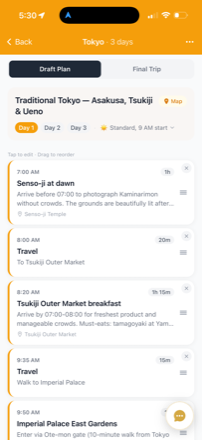
Get this guide as a tappable itinerary — freeDay-by-day plan, audio tours, one-tap Google Maps
Plan My TripRanked by locals. Sights, food, neighborhoods, and experiences that are actually worth your time \u2014 updated for 2026.
Powered by ITINE
Day-by-day plan, audio tours, and one-tap Google Maps — completely free.
Destinations
Your Itinerary
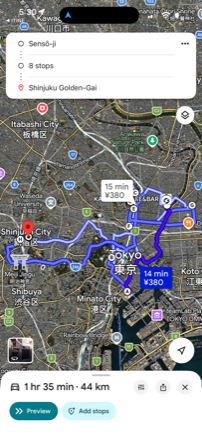
Google Maps
The single best thing to do in Lisbon is walk through Alfama at sunrise before anyone else is there.
Below are the 25 experiences that matter most \u2014 organized by number, not category, because the best Lisbon days mix sights, food, and wandering rather than treating them as separate items on a checklist. Practical info (cost, duration, best time) is included for every entry.
Alfama is Lisbon’s oldest neighborhood and the one that will stop you mid-stride. But arrive after 10 AM and you’re sharing it with a hundred selfie sticks. Come at 6:30–7 AM and the cobblestones are yours: washing lines, cats on windowsills, the faint sound of fado drifting from a ground-floor kitchen. There is nothing like it in Western Europe.
The custard tart debate is settled: Pastéis de Belém is the original, and the secret recipe has not changed since 1837. The pastry is flakier, the custard looser, the top more caramelized than anywhere else in the city. Eat them warm, dusted with cinnamon and powdered sugar, at a marble counter in the back rooms where the queue never reaches.
The castle has been here since the 11th century, occupied by Moors, Crusaders, and Portuguese royalty in sequence. The ramparts are what you come for: a 360-degree view over terracotta rooftops to the Tagus and the 25 de Abril bridge. Get there when it opens at 9 AM to beat the tour groups by at least an hour.
Manueline architecture at its absolute peak: the cloisters look like someone carved the entire ocean — ropes, coral, armillary spheres — into limestone. It was built on the profits of the spice trade, and the ambition shows. Vasco da Gama is buried here. Go on a Sunday morning when admission to the church is free and the cloister light is extraordinary.
The most scenic urban tram ride in Europe, passing through Alfama, Gracia, and Chiado on a route so steep the historic wooden trams groan audibly on the climbs. Locals still use it daily. Go outside peak hours — the mid-morning queues at the Martim Moniz terminus can be 45 minutes long. Or board mid-route at Campo de Ourique for a near-empty car.
Lisbon’s miradouros (viewpoints) all have their fans, but Graça is the locals’ choice. Less crowded than Da Graça’s more famous neighbor Santa Catarina, and set higher up, it gives you the castle on the left, the river ahead, and the entire city laid out in between. Bring beer from the kiosk, arrive 30 minutes before sunset, and you’ll understand why people move here.
Fado is not a tourist show — or it shouldn’t be. In the right casa de fado in Alfama, the performer stands two meters from your table and sings about longing and fate with a rawness that makes the hair on your arms stand up. Skip the tourist-facing houses on the main streets. Look for places with a minimum drinks charge and no tourist menu — that’s the filter.
Lisbon’s covered food hall brings together the city’s best chefs under one roof — Henrique Sá Pessoa’s stall, Alexandre Silva’s petiscos, fresh oysters, Alentejo wine. It’s touristy and crowded, especially on weekends, but the quality is high. Come for a late lunch on a weekday and it’s a different, calmer experience.
Forty minutes by train and you’re in a UNESCO World Heritage town of fairy-tale palaces perched in forested hills above the Atlantic. Pena Palace looks like a fever dream painted in yellow and red. The Moorish Castle has ramparts over a sea of eucalyptus. Quinta da Regaleira has a spiral initiation well that descends into the earth. One day is barely enough — go early.
A Gothic church burned in the 1755 earthquake and never rebuilt — deliberately kept as a ruin, open to the sky, with the original Gothic arches intact. Inside is a small archaeological museum with Egyptian mummies and pre-Columbian skulls. The combination of architectural melancholy and eccentric artifacts is deeply, distinctly Lisbon.
Operating since 1732, Bertrand holds the Guinness record as the world’s oldest operating bookshop. The azulejo-tiled interior and wood shelving feel unchanged. Even if you can’t read Portuguese, the experience of browsing here is worth the detour — and the English section is solid. Chiado’s best free attraction.
Lisbon’s best seafood restaurant has been operating since 1956 and shows no signs of slowing down. The menu is priced by weight: tiger prawns, percebes (barnacles), giant crab claws, and clams in garlic. Finish with a prego (steak sandwich) — it sounds strange after all that shellfish but is a Ramiro institution. Book ahead for dinner, or arrive at 12:15 for lunch.
A 19th-century industrial complex repurposed into studios, restaurants, and independent shops — and on Sundays, a market that takes over the central alley with ceramics, vintage, street food, and live music. It has become slightly more tourist-facing over the years, but the quality of vendors remains high and Landeau Chocolate (the best chocolate cake in Lisbon) is here year-round.
Lisbon’s azulejo tiles are not just decoration — they’re a 500-year-old archive of the city’s history, aesthetics, and obsessions. The best hunting grounds: the Museu Nacional do Azulejo (for context and the extraordinary 23-meter pre-earthquake panorama), the Oriente metro station (for free, spectacular contemporary panels by artists from five continents), and random walls in Alfama and Intendente for the raw, unguarded versions. This is one of those things that sounds minor and ends up defining the trip.
Príncipe Real is where Lisbon’s well-heeled locals live, and on Saturdays the gardens host a farmers’ market with olive oil, cheese, cured meats, organic produce, and some of the best pastries you’ll find outside a dedicated bakery. The neighborhood itself — antique shops, independent boutiques, the garden with its 200-year-old cedar — is worth an afternoon regardless.
The Museum of Art, Architecture and Technology opened in 2016 with an undulating white ceramic facade that spills down to the Tagus riverbank. You don’t have to pay for the museum — the rooftop walkway is free and gives one of the best river views in Lisbon, especially in late-afternoon light with the 25 de Abril bridge in the distance. A striking modern counterpoint to all that historic stone.
For €1.30 you get a 10-minute river crossing to Cacilhas, a working-class town on the south bank that feels nothing like tourist Lisbon. Turn around and look back: Lisbon glittering across the Tagus, the castle above, the 25 de Abril bridge to the left. Have a beer at a riverside terrace, watch the ferries go back and forth, and take the last light home. One of the most undervalued experiences in the city.
A Ginjinha is a bar that has been selling exactly one thing since 1840: ginjinha, a sour cherry liqueur served in a tiny cup. The bar is barely wider than a doorway on Largo de São Domingos, and the ritual is identical to what it has been for 180 years — you pay €1.50, you get your shot, you drink it at the counter. Order “com elas” to get a cherry in the cup.
After visiting the castle, resist the tourist route back down and instead descend through Mouraria — Lisbon’s most historically layered neighborhood, the birthplace of fado, and one of the least gentrified corners left in the city center. The descent takes 20 minutes and lands you at Rossio square, where you can recover with a bica (espresso) at a counter for €0.80.
Lisbon’s funiculars were built in the 1880s to solve the hill problem — and they’re still the most pleasant way to get up steep inclines. The Glória connects Restauradores to Bairro Alto in about 90 seconds and costs less than a Metro ticket. The yellow wooden cars are original. At the top, Miradouro de São Pedro de Alcantara gives you a free panorama across the city.
Lisbon’s centuries-old flea market sprawls across Campo de Santa Clara in Alfama every Tuesday and Saturday. Tiles ripped from demolished buildings, vintage Portuguese ceramics, old postcards, military surplus, and genuine antiques are jumbled together with outright junk. The hunting is the point. Come Tuesday morning when the professional dealers have not yet picked it clean.
The National Tile Museum is set inside a former convent and makes the definitive case for azulejo as fine art. The collection spans 500 years and includes a 23-meter panoramic tile panel depicting Lisbon before the 1755 earthquake — the only record of what the city looked like before the disaster. It is one of the most valuable historical documents in Portugal, and it’s painted in blue and white on a wall.
The grand riverfront square — the largest in Lisbon and one of the biggest in Europe — was the point where ships from the Age of Discovery departed and returned. In the last hour of daylight the ochre-yellow arcades glow, the bronze equestrian statue casts long shadows, and the Tagus turns copper. Walk through the Arco da Rua Augusta to the pedestrian street behind for a completely different perspective.
Technically this is in Cacilhas, on the south bank — but that’s part of the appeal. Ponto Final is a no-frills riverside restaurant with plastic tables, fresh grilled fish, and a view of Lisbon across the water that makes everything taste better. Order the fish of the day, a carafe of local white wine, and watch the ferries cross. The combination of simplicity and setting is one of the best meals you’ll have in Portugal.
The highest viewpoint in Lisbon, and the one most often missed by first-timers because the uphill walk through Gracia is not obvious. But the panorama from the top is the most complete in the city: the castle to the left, Alfama below, the Tagus and the bridge ahead, and the 25 de Abril’s south bank tower visible in clear weather. There is no kiosk, no gift shop, no tour buses. Just the view.
Items 1, 3, 6, 7 \u2014 Alfama at sunrise, the castle, sunset at Miradouro da Gra\u00e7a, and a fado house at night. You\u2019ll cover the emotional core of the city in 15 hours.
Full 1-Day Itinerary →Add items 2, 4, 5, 8, 10, 13, 18 \u2014 Bel\u00e9m in the morning of day two, Tram 28 in the afternoon, Time Out Market, LX Factory on Sunday if your dates align. Three days gets you the full version.
Full 3-Day Itinerary →Add the Sintra day trip (item 9) — full Sintra planning at sintraitinerary.com — the Cacilhas ferry (17 and 24 combined into one afternoon), Feira da Ladra on a Tuesday, and the Museu do Azulejo. By day five you\u2019ll have earned an opinion on which miradouro is best.
Full 5-Day Itinerary →Of the 25 items on this list, 11 are completely free. The paid items average \u20ac8\u201315 each. A day covering items 1, 3, 6, 10, 18 (Alfama sunrise, castle, Gra\u00e7a sunset, Carmo ruins, ginjinha) would cost under \u20ac25 per person, not including food or transport. Lisbon is the rare city where the most memorable experiences are also the most affordable.
out of 25 on this list
for paid sights and museums
including food and transport
See the full breakdown → Lisbon Budget Guide
Three to five days is the sweet spot. Three days covers Alfama, Belém, and Chiado without rushing. Five days lets you add Sintra, Cascais, and the neighborhoods most tourists skip entirely. Anything less than two days and you’re just scratching the surface.
Pastéis de nata (custard tarts), fado music, azulejo tiles, seven hills, and the Tagus river. Lisbon is also known for its trams — particularly Tram 28 through Alfama — and for being one of the oldest capital cities in Europe, pre-dating London, Paris, and Madrid.
Lisbon consistently ranks as one of Europe’s best-value capitals: the food is excellent, the weather is the best of any Western European city, the architecture is unlike anywhere else, and it’s far less crowded than Rome, Barcelona, or Paris. Most visitors leave wishing they’d stayed longer.
Three non-negotiables: Alfama at sunrise (before the tour groups arrive), pastéis de Belém fresh from the original 1837 bakery, and one fado night in a real Alfama casa de fado. Everything else is personal taste — but those three are the soul of Lisbon.
No — it’s one of Western Europe’s cheapest capitals. Budget travelers can get by on €50–80/day (hostel, pasteis, prato do dia lunches, local wine). Mid-range is €100–160/day (3-star hotel, sit-down dinners). You’d spend 40–60% more for the equivalent experience in London or Amsterdam.
Alfama to Belém in one perfect day
2DaysCastle, monastery, and Lisbon’s best neighborhoods
3DaysBairros, miradouros, and pastéis de nata
4DaysLisbon’s highlights plus a Sintra day trip
5DaysSintra, Cascais, and hidden Lisbon
7DaysEvery neighborhood, every tram line, every sunset